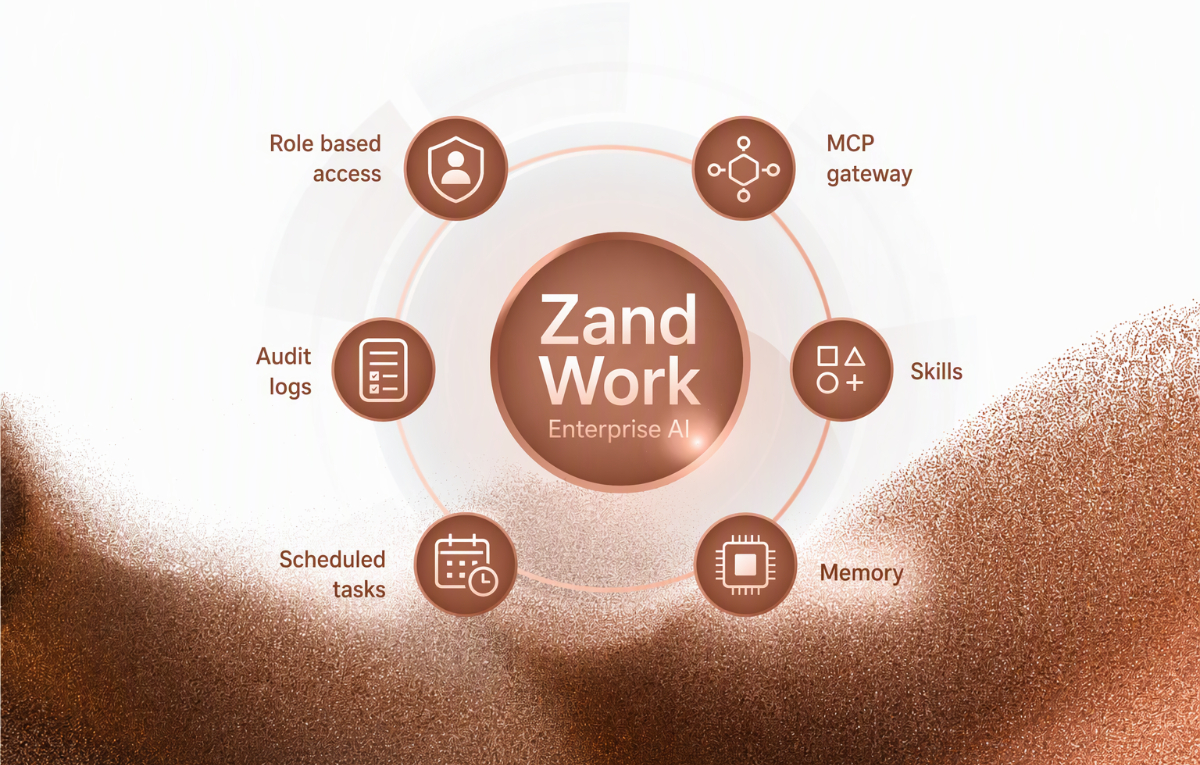
AI can answer almost any question. But answers are not work. A report still has to be built, a client file still has to be checked, a deck still has to be made. Today we are sharing a three-minute film of Zand Work, the home-grown work agent platform we built at Zand Bank in the UAE, where AI agents hand back finished work, and every step is logged and auditable.
Delivered work. Under audit.
Why we built it ourselves
Two years ago, we faced a choice every bank now faces: buy AI from a third party, or build our own agentic platform. We chose to build, for five reasons.
The model is not the hard part. Models get better and cheaper every few months. What a bank needs is everything around the model: secure execution, access to its own systems, and controls a regulator can inspect. That layer is where trust lives, and we did not want to rent it.
Built for regulation from day one. As a regulated bank, we must know where our data goes, who can act on it and what every system did. Building our own platform let us design those controls in from the very start.
Aligned with the UAE’s ambition. The UAE National AI Strategy calls for AI that is developed, governed and trusted here. Building our own platform in the UAE is our way of contributing to that ambition, not only consuming AI made elsewhere.
We wanted flexibility. We wanted the flexibility to choose any model, connect any system and adapt our cloud set-up as our needs evolve.
We had the right starting point. Zand is a digital bank with no legacy systems; everything already runs in the cloud. That made it possible to go from cloud-native to agent-native, and to build our own platform rather than bolt AI onto old infrastructure.
Our two-step strategy
Zand Work is the first step of a strategy with two parts, built on one platform.
Bank with the agents. Every team at Zand works with AI agents every day. We run our own bank on our own platform first, and over time we hope what we learn can help empower more enterprises across the UAE.
Bank for the agents. As AI agents begin to act, buy and pay on our behalf, they will need what people and companies already have: identity, trust, accounts and a way to settle. As a licensed bank, we see a natural role in helping to build that trust.
The first step proves the platform in the most demanding setting there is: a regulated bank. The second looks ahead to how that trust can serve the economy that agents will create.
Zand Work at a glance
Zand Work has three layers. Models at the bottom do the thinking. The harness layer in the middle, which we built ourselves, turns that thinking into finished work. The governance layer on top makes sure every step is secure, compliant and auditable.
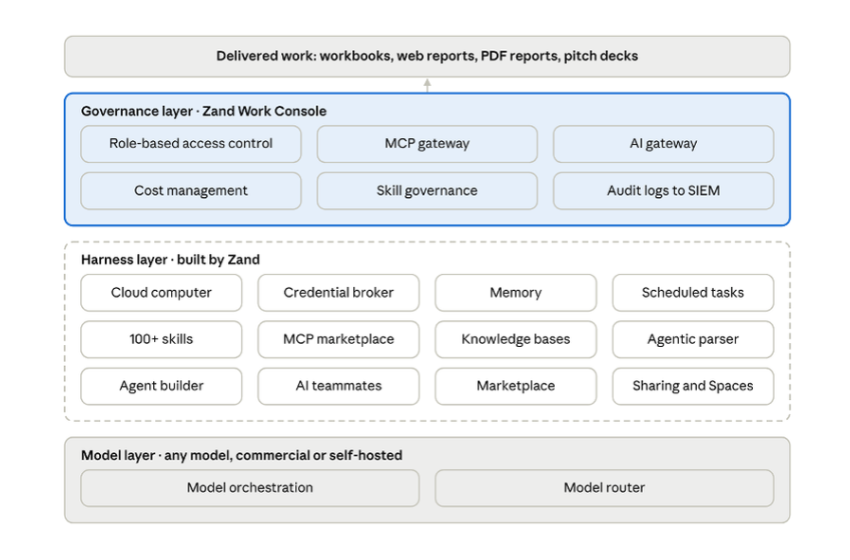
Zand Work architecture · three layers
Inside the three layers
Model layer: sovereign by design
For a bank, where a model runs matters as much as how well it runs. Our model layer is built around sovereign AI: sensitive data and the inference on it can stay in the UAE, including on models we run on our own GPUs. Model orchestration and the model router then send each task to the right model under those rules, balancing quality, data sensitivity and cost. Lower cost is a benefit; keeping data and inference under UAE jurisdiction is the point. And because Zand Work is not tied to any one provider, we can adopt better models as they arrive, without the teams using it ever noticing.
Harness layer: where agents actually do the work
This is the layer we built ourselves, and it is what turns a model into a colleague.
A secure cloud computer for every agent. Each agent works in its own isolated environment, with real compute and real files. A credential broker means agents never hold API keys or other secrets themselves, so nothing sensitive can leak from the cloud computer. It plans, executes and hands back the finished output. In the film you see it build a financial planning workbook in Excel, a forecast visualised as an interactive web report, a research report as a PDF, and an investor pitch deck, both as PowerPoint and as web slides that can be edited with AI in seconds.
Skills: our SOPs, turned into assets. Zand Work comes with more than 100 ready-made skills, and anyone can turn their own standard operating procedures into new ones. Every skill captures how our best people do the job, so it becomes a reusable asset of the bank that grows with every use. Skills are shared under full lifecycle and permission management: who can create, review, publish, use and retire each one.
Enterprise context through MCP. From our MCP marketplace, teams connect agents to the bank’s business systems. Data silos open up, and agents work with the context of how Zand actually operates, not just general knowledge. Every MCP connection comes with strict authentication, permission management and lifecycle management.
Knowledge bases and the agentic parser. Teams build knowledge bases from files, synced sources such as SharePoint, and even recorded meetings, which are transcribed and summarised. Our agentic parser reads what ordinary tools cannot: complex financial charts and scanned identity documents. Knowledge bases can be shared with specific roles.
Agents and AI teammates. Anyone can build an agent by choosing its instructions, skills, MCP connections and knowledge, then share or publish it. More than ten built-in AI teammates cover functions across the company, and with a simple @ mention several agents work together as a team.
Memory and scheduled tasks. Agents remember each user’s preferences, and users can open and edit that memory directly. Any task can be scheduled to run on its own, with every run’s results on record.
Secure sharing and a marketplace. Conversations, skills and agents can be shared by link with fine-grained permissions. Spaces show what you have shared and what others shared with you, and the marketplace lets every team discover knowledge bases, MCP connections, skills, AI teammates and prompts built by others.
Governance layer: the brain that keeps it safe
The Zand Work Console is what lets a regulated bank use all of this with confidence. It brings together:
- Role-based access control: who can use which agents, skills, data and tools
- MCP gateway: every connection to a business system passes through one controlled point, with strict authentication, permissions and lifecycle management for each MCP server
- AI gateway and model routing: every model call is authenticated, routed under data-residency rules and measured
- Skill governance: lifecycle and permission management for every skill, from creation and review to publishing, sharing and retirement
- Cost management: budgets and alerts by team, so spend stays visible and under control
- Audit logs: every chat, tool action, login and admin change is recorded and synced to the bank’s security monitoring
In short: agents do the work, and the bank stays in control of every step.
What’s next: AI that strengthens the UAE
Zand Work already runs across our bank, in compliance, risk, operations, HR, finance and customer service. Along the way, we have learned what it takes to make agentic AI work in one of the most demanding environments there is: governed, auditable and sovereign.
We believe those lessons matter beyond our own walls. Many organisations in the UAE want the productivity of agentic AI without giving up control of their data or their decisions. Working in step with our regulators and partners, we hope to help more enterprises across the country take that step with confidence.
This is how we see our part in the UAE National AI Strategy: not only adopting AI, but building it here, governing it here, and helping the nation lead in the agentic era.
Further ahead: when agents start to pay
Today, agents work for us. Soon they will also transact for us: booking, buying, paying suppliers, settling invoices, and eventually dealing directly with other agents. When that happens, the economy will need answers to questions it has never asked: Who is this agent? Who stands behind it? How far can it be trusted? How does it hold money, and how does it settle?
The frameworks for this new economy are still taking shape, across industry, standard setters and policymakers around the world. We believe a regulated bank has a natural role in it, because trust, identity and settlement are what banks have always provided.
So we have begun to prepare, responsibly and step by step:
Research and design. We are exploring how agents could be identified, verified and held accountable, a kind of “know your agent” to sit alongside know your customer.
Foundations we already run. The controls we built into Zand Work, from identity and permissions to budgets and audit trails, are the building blocks that agents able to pay safely will need.
Cloud-native rails. With no legacy systems, we are well placed to support this future, in line with the guidance of our regulators.
Working together. No single institution can build this alone. We look forward to working with regulators, banks, fintechs, technology companies and research institutions to shape it responsibly.
We built Zand Work to bank with the agents. We are preparing for the day we can also bank for them.
The agentic era is being built now
Every era of banking was defined by the people who built its rails. The agentic era will be no different, and it will not wait.
Two years ago, a small team at Zand decided not to wait for someone else to build it for us. Today, every team at the bank works with AI agents that deliver real work, under real governance, on a platform made in the UAE. Tomorrow, we hope to help more organisations across the UAE do the same, and to be ready when the agents they rely on need a bank they can trust.
We are only getting started. If you are building the future of work or finance in the agentic era, let’s build it together.
Delivered work. Under audit. Built in the UAE.